Grayson County Dog Registration Information
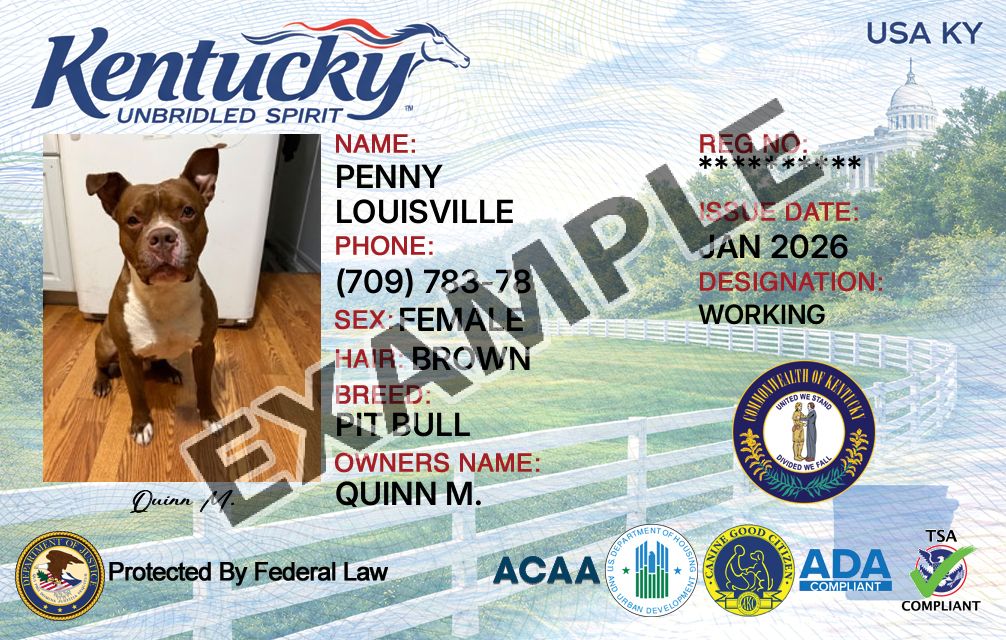
Service Dogs and Emotional Support Animals in Grayson, Kentucky
If you’re searching where do I register my dog in Grayson County, Kentucky for my service dog or emotional support dog, it helps to separate two different things: (1) local dog licensing (a county or city process tied to public health and identification), and (2) service dog or emotional support animal (ESA) status (legal definitions and documentation that are not handled through one universal federal registry). This page explains where to register a dog in Grayson County, Kentucky, what you may need, and how licensing is different from service dog and ESA rules.
Where to Register or License Your Dog in Grayson County, Kentucky
The offices below are the most relevant official local contacts identified for residents seeking an animal control dog license in Grayson County, Kentucky or guidance on animal services. Because licensing can vary by municipality (city limits) versus county areas, contacting the appropriate office for your address is the safest first step.
Grayson County Clerk’s Office
- Phone: (270) 259-3201
- Email: info@graysoncountyclerk.ky.gov
-
Hours:
Monday–Friday: 8:00 AM – 4:00 PMSaturday: 8:00 AM – 11:00 AM (2nd Saturday of each month)Sunday: Closed
Notes: The County Clerk is a common point of contact for local licensing services. If dog licensing is handled elsewhere for your area, the Clerk’s Office can typically direct you to the correct local agency.
Grayson County Animal Control (County Area / Outside Leitchfield City Limits)
Phone contact verified
- Phone: (270) 287-1132
Address, email, and office hours were not verified from an official county listing in the sources consulted. Call to confirm where to go in person (if needed) and what documentation is required for your location in Grayson County.
Leitchfield Animal Shelter / Leitchfield Animal Control (City of Leitchfield)
- Phone: (270) 230-8839
- Email: adoptlaspets@gmail.com
-
Hours:
Monday–Friday: 10:00 AM – 4:00 PMSaturday: 10:00 AM – 12:00 PMSunday: Closed
Notes: This office lists animal control support within Leitchfield city limits and references licensing enforcement. If you live in Leitchfield, start here for city-specific animal control guidance; for areas outside city limits, use the county animal control phone above.
Overview of Dog Licensing in Grayson County, Kentucky
What “registering” a dog usually means locally
When people ask where to register a dog in Grayson County, Kentucky, they are usually referring to a local dog license (sometimes called a “tag” or “license tag”). A dog license is typically a local government process used to:
- Link a dog to an owner for identification and reunification if the dog is found
- Support rabies vaccination compliance and bite/quarantine investigations
- Support local animal services operations and enforcement
County vs. city requirements (why your address matters)
In Kentucky, dog regulation often involves a mix of county-level practices and city ordinances. Within Grayson County, requirements can differ depending on whether you live inside a municipality (such as Leitchfield city limits) or in the county area outside city limits. If you are unsure which rules apply, contact the office listed above that matches your location (city vs. county).
What You Need Before Registering a Dog
Common documents and information to prepare
Although exact dog licensing requirements in Grayson County, Kentucky can vary by jurisdiction, most local licensing processes ask for similar basics. Having these ready can speed things up:
- Proof of rabies vaccination (current rabies certificate from a veterinarian)
- Your contact information (name, phone number, and home address)
- Basic pet details (dog’s name, breed/description, color/markings, age/approximate date of birth)
- Spay/neuter documentation (if your local fee structure differs based on altered status)
- Payment method for any license/tag fees (amounts can vary)
Rabies vaccination and tags
Local agencies commonly require proof of a current rabies vaccination to issue a license/tag. Even if you are licensing a dog that is also a service dog or an emotional support dog, rabies vaccination requirements still typically apply.
Steps to Register or License a Dog in Grayson County, Kentucky
1) Confirm the correct licensing office for your address
Start by identifying whether you live inside Leitchfield city limits or in the broader county area. If you’re asking “animal control dog license Grayson County, Kentucky,” the most direct next step is to call the county animal control contact listed above and ask where licensing is processed for your specific address.
2) Gather proof of rabies vaccination (and any supporting documents)
Request an up-to-date rabies certificate from your veterinarian. If your dog was vaccinated recently, ensure you have documentation that shows:
- Date of vaccination
- Rabies vaccine product and duration (e.g., 1-year or 3-year, if indicated)
- Veterinary clinic name and veterinarian information
- Dog identification details (name/description)
3) Apply for the license/tag through the local office
Depending on local practice, you may apply in person and receive a tag, or you may be instructed to submit documentation and payment through the office’s preferred method. Ask the office:
- Whether licensing is annual and what the renewal timeframe is
- Whether fees differ for spayed/neutered dogs
- Whether you must present documentation in person or can submit copies
- What to do if you move within Grayson County or change addresses
4) Keep the tag and documentation accessible
Keep a copy of your licensing receipt (if issued) and rabies certificate in a safe place. If your dog wears a collar, ask whether the local office recommends keeping the tag on the collar for quick identification.
Service Dog Laws in Grayson County, Kentucky
Service dogs: legal status vs. local licensing
A service dog is generally understood as a dog trained to do specific tasks for a person with a disability. That legal status is separate from whether your local area requires a dog license in Grayson County, Kentucky. In other words:
- Service dog status is about the dog’s training and the handler’s disability-related need.
- Dog licensing is a local government identification/public health requirement that may still apply.
No universal federal “service dog registration”
If you were told you must “register your service dog with the federal government,” that is usually a misunderstanding. There is not one universal federal registry that is required to make a dog a service dog. Some handlers choose to use optional items like ID cards, vests, or training documentation, but these are not the same thing as a government-issued licensing requirement.
Local expectations still matter (rabies, leash rules, nuisance rules)
Even when a dog is a legitimate service dog, local animal rules can still apply, such as rabies vaccination requirements and general public safety rules (leash control where required, preventing nuisance behavior, and keeping the dog under control).
Emotional Support Animal Rules in Grayson County, Kentucky
What an emotional support animal (ESA) is—and isn’t
An emotional support animal (often called an “emotional support dog”) is typically an animal that provides comfort through companionship, and the need is usually documented in a housing context. ESAs are different from service dogs because ESAs are not necessarily trained to perform disability-related tasks.
No universal federal ESA registration
Like service dogs, ESAs are not “made official” by a single federal registry. ESA status is usually supported by documentation from a qualified professional for specific purposes (commonly housing). That documentation does not replace local dog licensing.
ESA vs. public access
ESA status does not automatically grant the same public-access rights as a trained service dog. If you’re deciding what paperwork you need, focus first on (1) local dog licensing requirements Grayson County, Kentucky and rabies documentation, and (2) the specific setting where you need accommodation (most commonly housing).
Dog License vs. Service Dog vs. Emotional Support Animal (ESA)
| Category | Dog License (Local) | Service Dog | Emotional Support Animal (ESA) |
|---|---|---|---|
| What it is | A local license/tag tied to your dog and address for identification and compliance. | A dog trained to perform tasks for a person with a disability. | An animal that provides emotional support/comfort; typically relevant in housing accommodation contexts. |
| Who issues it | County or city office (varies by location within Grayson County). | No universal federal registry; status is based on training and disability-related need under applicable law. | No universal federal registry; commonly supported by documentation for specific accommodations (often housing). |
| Common requirements | Often requires proof of rabies vaccination; may require fee and owner contact details. | Training to perform specific tasks and to remain under control in public settings. | Documentation may be requested for accommodation in relevant settings; training is not the defining requirement. |
| Does it replace local licensing? | Not applicable. | No. A service dog may still need a local dog license/tag where required. | No. An ESA may still need a local dog license/tag where required. |
| What it helps with | Reuniting lost pets, proof of compliance, and local enforcement. | Access and accommodation in certain public contexts when the dog meets the legal definition. | Accommodation in certain contexts, commonly housing, when appropriate documentation is provided. |
Frequently Asked Questions
Local note: If any office details above do not match what you encounter when you call, ask for the current licensing contact for your municipality or the county area where you live. Local rules and responsibilities can shift over time, especially between city limits and unincorporated county areas.
Register A Dog In Other Kentucky Counties
Select your county below to get started with your dog’s ID card. Requirements and license designs may vary by county, so choose your location to see the correct options and complete your pup’s registration.
- Adair County Dog Registration
- Allen County Dog Registration
- Anderson County Dog Registration
- Ballard County Dog Registration
- Barren County Dog Registration
- Bath County Dog Registration
- Bell County Dog Registration
- Boone County Dog Registration
- Bourbon County Dog Registration
- Boyd County Dog Registration
- Boyle County Dog Registration
- Bracken County Dog Registration
- Breathitt County Dog Registration
- Breckinridge County Dog Registration
- Bullitt County Dog Registration
- Butler County Dog Registration
- Caldwell County Dog Registration
- Calloway County Dog Registration
- Campbell County Dog Registration
- Carlisle County Dog Registration
- Carroll County Dog Registration
- Carter County Dog Registration
- Casey County Dog Registration
- Christian County Dog Registration
- City of Lexington County Dog Registration
- City of Louisville County Dog Registration
- Clark County Dog Registration
- Clay County Dog Registration
- Clinton County Dog Registration
- Commonwealth of Kentucky County Dog Registration
- Crittenden County Dog Registration
- Cumberland County Dog Registration
- Daviess County Dog Registration
- Edmonson County Dog Registration
- Elliott County Dog Registration
- Estill County Dog Registration
- Fayette County Dog Registration
- Fleming County Dog Registration
- Floyd County Dog Registration
- Franklin County Dog Registration
- Fulton County Dog Registration
- Gallatin County Dog Registration
- Garrard County Dog Registration
- Grant County Dog Registration
- Graves County Dog Registration
- Green County Dog Registration
- Greenup County Dog Registration
- Hancock County Dog Registration
- Hardin County Dog Registration
- Harlan County Dog Registration
- Harrison County Dog Registration
- Hart County Dog Registration
- Henderson County Dog Registration
- Henry County Dog Registration
- Hickman County Dog Registration
- Hopkins County Dog Registration
- Jackson County Dog Registration
- Jefferson County Dog Registration
- Jessamine County Dog Registration
- Johnson County Dog Registration
- Kenton County Dog Registration
- Knott County Dog Registration
- Knox County Dog Registration
- LaRue County Dog Registration
- Laurel County Dog Registration
- Lawrence County Dog Registration
- Lee County Dog Registration
- Leslie County Dog Registration
- Letcher County Dog Registration
- Lewis County Dog Registration
- Lincoln County Dog Registration
- Livingston County Dog Registration
- Logan County Dog Registration
- Lyon County Dog Registration
- Madison County Dog Registration
- Magoffin County Dog Registration
- Marion County Dog Registration
- Marshall County Dog Registration
- Martin County Dog Registration
- Mason County Dog Registration
- McCracken County Dog Registration
- McCreary County Dog Registration
- McLean County Dog Registration
- Meade County Dog Registration
- Menifee County Dog Registration
- Mercer County Dog Registration
- Metcalfe County Dog Registration
- Monroe County Dog Registration
- Montgomery County Dog Registration
- Morgan County Dog Registration
- Muhlenburg County Dog Registration
- Nelson County Dog Registration
- Nicholas County Dog Registration
- Ohio County Dog Registration
- Oldham County Dog Registration
- Owen County Dog Registration
- Owsley County Dog Registration
- Pendleton County Dog Registration
- Perry County Dog Registration
- Pike County Dog Registration
- Powell County Dog Registration
- Pulaski County Dog Registration
- Robertson County Dog Registration
- Rockcastle County Dog Registration
- Rowan County Dog Registration
- Russell County Dog Registration
- Scott County Dog Registration
- Shelby County Dog Registration
- Simpson County Dog Registration
- Spencer County Dog Registration
- Taylor County Dog Registration
- Todd County Dog Registration
- Trigg County Dog Registration
- Trimble County Dog Registration
- Union County Dog Registration
- Warren County Dog Registration
- Washington County Dog Registration
- Wayne County Dog Registration
- Webster County Dog Registration
- Whitley County Dog Registration
- Wolfe County Dog Registration
- Woodford County Dog Registration